Fashion
How to Choose Heels You Can Actually Walk In
Height is only one of the things that decides whether a heel will get you through the night.
Heel height is only one factor in comfort. Shape, base width, the shoe's flex, the fit across the ball of the foot and how many hours you stand all matter. Use the comfort band tool to judge a pair, and choose a wider or shorter heel for long days.
Height is not the only measure
Most people judge heels by height. A 5 cm pump and a 5 cm stiletto can feel completely different, because the stiletto puts most of your weight on a narrow point and the pump spreads it across a wider base. Comfort depends on how the weight is distributed, how the shoe bends and whether it fits your foot.
Start with the question you actually need answered: how many hours will you be standing or walking, and on what surface? A reception on carpet and a street festival on cobbles call for different shoes at the same height.
Use the comfort band
Enter the heel height and the hours you expect to spend on your feet. The result is a simple band, not a medical opinion. It gives you a starting point for choosing a shoe and deciding whether to pack a second pair.
Heel comfort band
Enter the heel height and the hours you will be on your feet.
What makes a heel comfortable
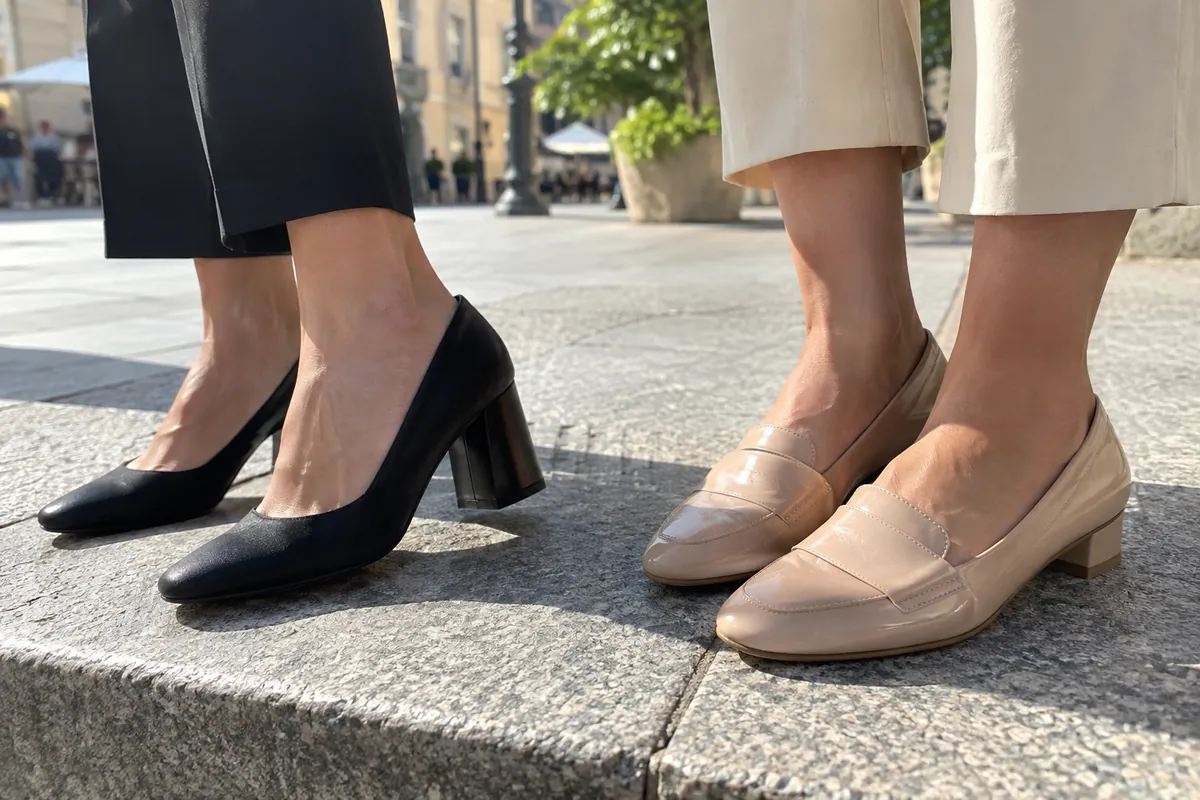
Base width. A wider heel, such as a block or a sturdy stacked heel, spreads pressure and is much easier to stand in. It also gives you more stability on uneven ground.
Shape of the toe box. Look for room across the ball of the foot. If your toes are cramped on the try-on, the heel will feel worse after an hour, not better.
Flex. Bend the shoe at the ball of the foot. A shoe that bends easily with your foot will feel natural. A stiff shoe will press on the sole and make every step harder.
Platform. A small platform under the front of the shoe reduces the effective heel height. A 10 cm heel with a 3 cm platform feels closer to 7 cm, though it is still demanding for long days.
Insole and padding. Thin, firm insoles usually lose their cushioning first. A gel or cork insole, or a ball-of-foot cushion, can add real comfort for a modest cost.
Try on properly
Shop in the afternoon, when feet are slightly larger, and wear the tights or socks you plan to wear with the shoes. Stand, walk up and down a staircase if the store has one, and stand still for at least five minutes. Pay attention to pressure points at the ball of the foot, the heel counter and the top of the foot.
Good heels should feel supported after five minutes of standing. If a shoe only feels fine in the first minute, it will hurt before the evening is over.
Heel by heel, what suits which day
Low heels, 2 to 4 cm. Suitable for long days, office work, travel and most events. Pumps, loafers with a small heel and low block heels all fit this group.
Mid heels, 5 to 7 cm. A good balance for evenings out and short events. Choose a wide base or a block heel if you will be on your feet for more than four or five hours.
High heels, above 7 cm. Best for short periods: a dinner, a photo session or a single event where you can sit between moments. Carry flats or a second pair for the rest of the day.
Protect your feet during a long day
Bring a pair of flat shoes or sandals for travel and changes. Use gel heel grips or ball-of-foot cushions for the event itself. Take breaks off your feet where you can, and stretch your calves between sets of standing.
Blisters often come from new shoes. Break a pair in at home for an hour or two before the event, not the day before.
When heels are a bad idea
Stop wearing heels and see a doctor if you have persistent foot, ankle, knee or back pain, numbness or tingling, or a condition that affects circulation or balance. A podiatrist can advise on orthotics or specific footwear for those situations.
A worked example: a wedding day
Picture a day that begins with a morning photo session, a ceremony at noon and a reception that runs until midnight. That is at least ten hours on your feet, and perhaps six of them are in heels.
Here is a realistic plan. For the photos, wear low block heels or flat loafers, since you will be walking on gravel and standing for long periods. For the ceremony, a pair of mid heels with a wide base is fine, because you can stand still for half an hour. For the reception, carry a second pair of flats in a bag and change after the speeches, when the dancing begins and the evening gets longer.
The comfort band helps set the rule. A 5 cm heel for six hours falls in the moderate band, so a wide base and one change of shoes are sensible. A 9 cm stiletto for six hours falls in the demanding band, and you would plan for short wear only. Use the band to decide what you wear, not only what you like best.
Frequently asked questions
Are wedge heels more comfortable?
Often, because the sole is continuous and spreads pressure. They can still be tiring over long periods, so the band still applies.
Do I need a half size up?
Sometimes. A heel with a narrow toe box or a pointed shape can feel tight after a few hours, so a half size can help with a fuller forefoot. Always check the fit at the ball of the foot.
How do I stop heels from slipping?
Choose a shoe with a stable heel counter and a fastening, such as a strap or ankle buckle. Thin, slippery soles are the most common cause of slipping, so look for a textured sole.
Can thrifted heels be comfortable?
Yes, if the soles, heel tips and insoles are in good condition. Use the thrift checklist to inspect them before buying.
Related reading
For a wedding or formal event where you will be standing for hours, read what to wear to a wedding as a guest to match the shoes to the dress code.